
Nebraska Sweeps Creighton 3-0 Before 15,405 Fans: The Record Sits in the Stands, the Lesson Sits in the Data
**Câu trả lời cốt lõi**: Nebraska (xếp hạng 1) thắng Creighton (xếp hạng 20) 3-0 với các tỷ số 25-13, 25-15, 25-19 trong trận bóng chuyền nữ NCAA ngoài hội nghị, trước 15.405 khán giả tại Pinnacle Bank Arena — kỷ lục khán giả trong nhà của chương trình. Nebraska ghi bốn điểm ace ở ván 2 và có sáu cầu thủ khác nhau ghi kill trong bảy điểm đầu. **Dữ kiện chính**: - Nebraska hiệu suất tấn công ván 1 đạt .444; Creighton đạt −0.065 ở ván 1 và .000 ở ván 2. - Ván 2: Nebraska bứt từ 12-12 bằng chuỗi 11-3, ghi bốn ace trực tiếp. - Nebraska thành tích 8-0, xếp hạng 1; Creighton 5-5 với chuỗi ba trận thua trước trận này. - Đối đầu lịch sử: Nebraska thắng cả 25 lần chạm trán; lần đầu thắng Creighton 3-0 kể từ 2021. - Đây là trận ngoài hội nghị (Nebraska thuộc Big Ten, Creighton thuộc Big East), không ảnh hưởng thứ hạng hội nghị. **Nguồn**: NCAA.com và bản tin WOWT (bản tin trận Nebraska – Creighton). Ngày công bố không được ghi rõ trong tài liệu nguồn. Các chỉ số chắn bóng, đỡ bóng và đỡ phát bóng hoàn hảo không có trong tài liệu nguồn. **Hỏi đáp liên quan**: - Q: Vì sao hiệu suất tấn công có thể âm? A: Công thức là (kill trừ lỗi tấn công) chia tổng lần đập, nên khi lỗi nhiều hơn kill kết quả ra số âm, như trường hợp Creighton −0.065 ở ván 1. - Q: Kỷ lục 15.405 khán giả có ý nghĩa gì về mặt thương mại? A: Nó cho thấy sức chứa thị trường cho bóng chuyền nữ đại học lớn hơn giả định của các mô hình bản quyền truyền thông truyền thống. - Q: Có thể kết luận Nebraska chắc suất vô địch từ trận này không? A: Không, vì đối thủ đang khủng hoảng tấn công và đây là trận ngoài hội nghị; cần đánh giá thêm qua giai đoạn thi đấu Big Ten.
Nebraska Sweeps Creighton 3-0 Before 15,405 Fans: The Record Sits in the Stands, the Lesson Sits in the Data
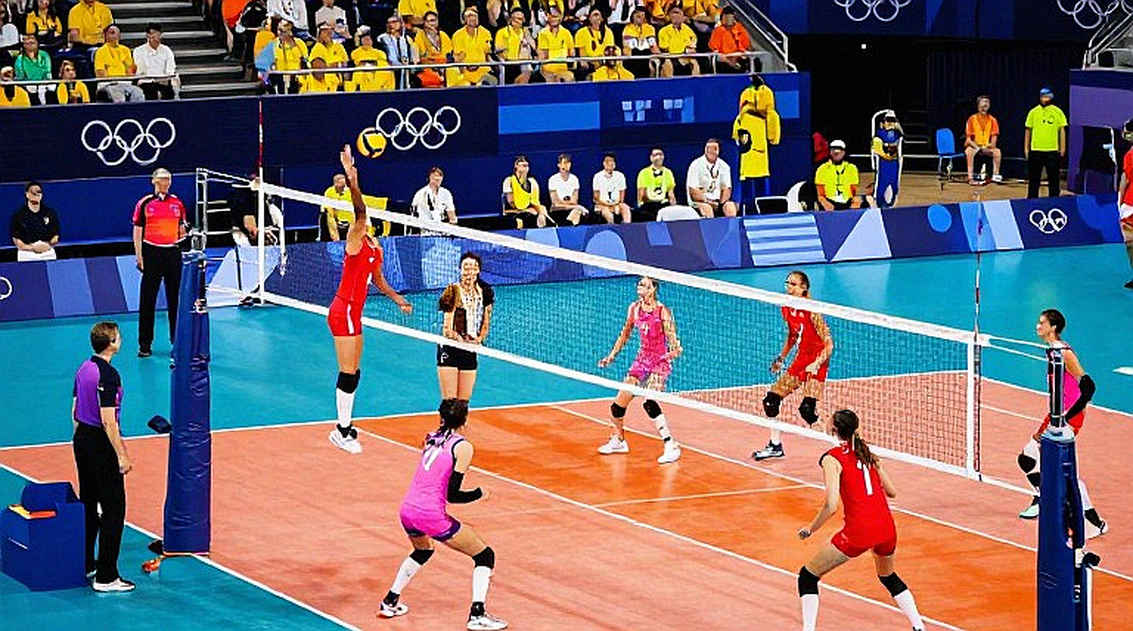
11:47 p.m., Binh Duong time. The coffee had gone cold long before. On the official NCAA stream, the stands at Pinnacle Bank Arena in Lincoln, Nebraska were lit and full. No medal was being awarded there. No Olympic berth was being decided. There was only a regular women's volleyball match between Nebraska and Creighton — two universities in the same state, roughly two hours apart along the I-80 corridor.
15,405 people sat under that roof. A program indoor attendance record for Nebraska women's volleyball fell during a match that does not count toward conference standings. I wrote 15,405 in my notebook before I wrote the 3-0 scoreline. In my order of things, that sequence is the correct one.
Three sets closed it out: 25-13, 25-15, 25-19. Nebraska won. Creighton lost. Anyone glancing at a box score knows that in three seconds. But stopping there skips two larger stories: how Nebraska built the win on serve pressure and a spread attack, and why more than fifteen thousand people paid to watch collegiate women's volleyball on a weeknight.
I used to clap from the stands; now I sit at the commentary desk so others do not have to clap alone. But the stands in Lincoln that night did not need a stand-in. They showed up on their own.
Nebraska at No. 1, Creighton at No. 20 — and a 25-0 all-time series
To read this match correctly, a few baseline facts come first.
Nebraska entered at No. 1 nationally with an 8-0 record. Creighton stood at No. 20 with a 5-5 record and a three-match losing streak. Historically, Nebraska had won all 25 prior meetings. It was also Nebraska's first 3-0 win over Creighton since 2026 — meaning that in recent years, the Huskers usually dropped at least one set to the Bluejays despite winning.
On format, NCAA Division I plays rally-point, best-of-five: four sets to 25, a deciding set to 15. A 3-0 sweep is not merely a comfortable margin on paper; it saves the starters' legs, keeps the rotation intact, and reduces accumulated injury risk during the non-conference portion of the schedule. For a team chasing a national title, three sets instead of five is a real saving.
One point is worth stressing because casual readers miss it: this was a non-conference match. Nebraska plays in the Big Ten; Creighton plays in the Big East. The result does not affect either team's conference standing. Competitively, the stakes were low. That is partly why Nebraska's staff could rotate freely, test lineups, and play a lower-risk brand of volleyball.

And precisely because the stakes were low, 15,405 matters more. Nobody came for a qualification berth. They came because this program has become part of local identity.
Reading the match through data: the first two sets are an indictment
The core data table for this match fits in a few lines. Every line is heavy.
Nebraska's team hitting percentage in Set 1 was .444. Creighton's in Set 1 was −0.065. In Set 2, Creighton hit .000.
For readers unfamiliar with American volleyball statistics: hitting percentage is (kills minus attack errors) divided by total attack attempts. Because the formula can produce a negative result, a negative team hitting percentage means a side committed more attack errors than it recorded kills. In elite NCAA women's volleyball, .300 is very good. .444 is the mark of a team swinging through the opposing block as if into open space. And −0.065 is the mark of a team beating itself.
Core insight one: Nebraska did not win because one star shone; it won because no star was forced to. Across the first seven points of the match, six different Huskers recorded a kill. Six players, seven points. That is the fingerprint of a spread offense — the ball distributed across positions, the setter not locked onto one option, and the opposing block given no anchor to read.
This matters more than it looks. A team dependent on one primary attacker can win its first eight matches, then collapse once an opponent neutralizes that player. A team distributing to six hitters is far harder to neutralize. Early attacking balance is a signal of roster depth, and roster depth is what decides November, not September.
Core insight two: serving was the tiebreaker. In Set 2, the score stood at 12-12. From there, Nebraska uncorked an 11-3 run to close the set at 25-15. During that run, Nebraska scored four direct service aces.
Four aces in one set is not trivial. But the true value is not the four points. It is in the points that never appear in a box score: the occasions Creighton was forced into poor first contacts, could not run its system, and had to push the ball over from a passive position. A hard serve that scores directly is good. A hard serve that dismantles an opponent's entire rotation is what kills a set.
When a 12-12 score collapses into 12-23 within a handful of rallies, that is usually the signature of a stuck rotation — a side that cannot escape its setter's position or its right-back defensive slot. Nebraska attacked exactly that spot.
Set 3 was the only relatively competitive set. 25-19, a six-point margin. For a team down 0-2 after hitting negative and zero, still scoring 19 in the final set is a small but worth-noting sign. It suggests Creighton's first two sets were a systemic problem rather than a psychological one.
One thing the data does not give must be said plainly: the source material provides no blocking, digging, or perfect-pass statistics. Without those three groups, we cannot conclude with certainty why Creighton hit so poorly. We know the outcome, not the mechanism. The most plausible inference is that Nebraska's block and back-court defense applied sustained pressure, forcing Creighton into lower-quality attack choices. But that is inference, not fact.
Being honest with data is part of this job. I have written wrongly before by concluding too fast, and I do not intend to repeat it.
Creighton: three straight losses and a genuine attacking crisis
What makes this defeat more worrying than an ordinary one is the surrounding context.
Creighton entered at 5-5 with a three-match losing streak. After this match, the streak became four. A team ranked No. 20 nationally losing four straight is no longer a matter of temporary form.
Two sets at −0.065 and .000 say something very specific: Creighton could not terminate rallies. In volleyball, there are two roads to a negative hitting percentage. One is repeatedly hitting out of bounds or into the block. The other is hitting too softly — easy for the opponent to defend but still counted as an error when blocked. Both roads lead to the same destination: the opponent controls the match.
For a program around the No. 20 mark, a negative set is rare. A negative set followed by a zero set against the same opponent is a red flag.
Having followed many cycles of collegiate women's volleyball, the pattern usually traces to one of three causes: an injury at setter or primary attacker, an abrupt lineup change that disrupted coordination, or a sudden spike in schedule strength. The source material names none of these. Without additional reporting, any judgment is speculation.
What is certain: Creighton has an attacking problem, and it has persisted across multiple matches.
The contrarian angle: the attendance record is the real story, and the 3-0 is secondary
This is where I want to push against the conventional framing.
Most reports on this match will open with the 3-0 and close with Nebraska remaining unbeaten. That framing is not wrong, but it places the emphasis in the wrong spot.
Look at the competitive substance. The No. 1 team beat the No. 20 team that had lost three straight, in a non-conference match with no standings impact. Nebraska won 25-13, 25-15, 25-19. That result matches the talent gap exactly. If this is the only match you know about this season, you know nothing about Nebraska's title credentials.
Core insight three: a 3-0 sweep of a struggling opponent proves nothing about peak strength. It proves only that the stronger team did what stronger teams are supposed to do. To learn whether Nebraska is genuinely title-caliber, wait until it faces a top-five opponent, or until it enters Big Ten conference play, where the density of strong opponents is far higher.
Meanwhile, 15,405 fans is an irreversible fact. It does not depend on whether Creighton is losing or winning. It does not depend on whether Nebraska won 3-0 or 3-2. It says that more than fifteen thousand people were willing to pay, rearrange their schedules, and travel to a downtown arena to watch collegiate women's volleyball.
This is the point I want women's sports builders in Vietnam to write down.
For years, the standard argument used to justify underinvesting in women's sports has been: there is no audience. No audience means no money, no money means no quality, no quality means even less audience. A tidy vicious circle, convenient for anyone who does not want to change.
The 15,405 in Lincoln is a piece of evidence against that circle. But it must be read correctly. The crowd did not come merely because it was women's volleyball. They came because the Nebraska program had been built over decades, because this university had turned volleyball into a local tradition, and because organizers decided to move the match to a large downtown arena instead of the on-campus facility.
That last detail is notable and rarely mentioned. Staging the match at Pinnacle Bank Arena was a strategic decision. The arena sits downtown, has a larger capacity than the campus venue, and is reachable by people who are not students. It is how a campus sports event becomes a city event.
Nebraska has played three matches at that arena and won all three. But the 3-0 record there is not the point. The point is the model: take the women's team out of the campus bubble, place it downtown, and let the public see that this team belongs to them.
This is a transferable lesson, not an American peculiarity. The model does not depend on a huge dollar budget. It depends on one decision: put the women's team somewhere visible instead of somewhere forgettable.
Commercial value and competitive value are two different roads
There is a confusion I see repeated in how people talk about women's sports.
People often merge commercial value and competitive value into one lump. If a women's team sells tickets, people say the team is good. If it does not sell tickets, people say the team is not good enough. That merging is logically wrong, and it harms women's sports itself.
The Nebraska–Creighton match is a clear illustration of the two roads running separately.
On competitive value, this match ranked low. The opponent was in an attacking crisis. It was a non-conference game. The result matched the talent gap. No tactically pivotal rally was recorded.
On commercial value, this match ranked high. 15,405 fans is a program indoor record. It proves that the market for collegiate women's volleyball in an agricultural Midwestern state is far larger than conventional media business models assume.
Judge this match by competitive standards and it is short-shelf-life news, worthless within days. Judge it by commercial standards and you have a long-term reference point.
There is a professional consequence worth stating clearly. Many streaming platforms are paying ever-higher rights fees on the assumption that broadcast rights will generate profit. That model already failed once in traditional cable television. When a collegiate women's volleyball program sells more than fifteen thousand tickets for a midweek match, the real value lies in the live arena experience, not in the rights package.
The pitch does not ask about gender; it asks only whether you dare stand up. But the stands ask a different question: were people invited to come?
From Lincoln, looking back toward Binh Duong
I write these lines from Binh Duong, where I have spent nearly forty years observing sport, and where the last seven have been devoted largely to Vietnamese women's football and women's volleyball.
When I started the Binh Duong Sports Her channel in 2026, the first video — an interview with a women's midfielder — drew 300 views. A long article about her circumstances, about selling lottery tickets to fund her passion, was shared by a local community page and lifted the channel to 12,000 followers within a week.
I retell that detail not to talk about myself. I retell it to say that the story of audience demand for women's sports in Vietnam was never a story about lack of interest. Three hundred views and twelve thousand followers come from the same community; the difference is whether the story reached them.
The same thing is happening in Lincoln, at a far larger scale.
The distance between 300 and 12,000 is not a distance of resources. It is a distance of storytelling. And the distance between 12,000 and 15,405 is much the same: most of the work is not convincing people to care, but bringing the event somewhere they can reach.
Equality does not mean everyone finishes at the same line; it means everyone starts from a fair one. In women's sports, a fair starting line usually begins with very concrete decisions: which arena, which broadcast slot, and how many seconds of pre-match lineups.
Signals to keep tracking
Professionally, there are four signals I will keep watching in the coming weeks.
First, Nebraska's record once Big Ten play begins. The 8-0 start may reflect a soft early schedule. The simplest test is to wait for the first loss or the first narrow five-setter.
Second, the cause of Creighton's slide. If the streak extends and a change appears at setter or in the starting lineup, that points to a structural problem rather than a form dip.
Third, Nebraska's attacking balance. If one hitter begins taking the majority of attempts in coming matches, the system is narrowing around one person — and that is the biggest tactical risk a top program can carry.
Fourth, the attendance trajectory. If future matches at Pinnacle Bank Arena keep filling or exceeding 15,405, the story of commercial growth in collegiate women's volleyball gains more data. If the number drops sharply, the record is an event rather than a trend.
I am leaving these four signals in my notebook without concluding in advance.
What remains
The three sets in Lincoln finished in about ninety minutes. Nebraska won on serve pressure, a tight block, and an attack spread across six players. Creighton lost because it could not terminate rallies, and because it arrived already sliding.
Those lines will sit in the season file and be forgotten within weeks.
The 15,405 will not be forgotten that way. Fifteen thousand four hundred and five people paid to witness a collegiate women's volleyball match on a weeknight, in a city where twenty years ago nobody imagined this day.
When a women's sport sells out, do not ask why they won that night. Ask why, on all the nights before, nobody was invited.