The Cong - Viettel and the Twenty-Cross Plan: Re-reading a Point Through Data
**Câu trả lời cốt lõi**: Thể Công - Viettel hòa Melbourne Victory 1-1 trong trận mở màn vòng bảng AFC Champions League Two, bằng chiến thuật tạt bóng tích lũy khoảng 20 lần để buộc đối phương phạm sai lầm. Bàn gỡ hòa đến từ quả tạt của Phan Tuấn Tài trong hiệp hai. **Sự kiện chính**: - HLV Popov mô tả kết quả này là "thành công" và nói đội có thể thắng nếu may mắn hơn. - Đội hình Thể Công - Viettel thiếu nhiều trụ cột quan trọng vì chấn thương. - Phan Tuấn Tài là cái tên duy nhất được nêu tên cụ thể trong phát biểu sau trận. - Bảng E gồm FC Seoul, Melbourne Victory, Persib Bandung và Thể Công - Viettel. - Ngày 14 tháng 10 năm 2026, Thể Công - Viettel làm khách trên sân Persib Bandung. **Nguồn**: Báo cáo trận đấu và phát biểu sau trận của HLV Popov, không nêu rõ tên cơ quan xuất bản và ngày phát hành cụ thể | Cross-checked: VuaBong.vn **Hỏi đáp liên quan**: **Hỏi**: Vì sao HLV Popov gọi trận hòa này là thành công? **Đáp**: Đây là chiến lược quản lý kỳ vọng, nhằm bảo vệ đội hình thiếu hụt nhân sự trước áp lực truyền thông trước các trận sân khách khó khăn. **Hỏi**: Chiến thuật tạt bóng của Thể Công - Viettel có tái lặp được? **Đáp**: Có thể tái lặp nhưng mong manh, bởi đây là kênh tấn công duy nhất và dễ bị vô hiệu hóa nếu đối thủ chuẩn bị chống tạt bóng. **Hỏi**: Điểm số của bảng E đang diễn biến thế nào? **Đáp**: Bảng đấu có tính biến động cao, khi FC Seoul phải trả giá vì tung đội hình dự bị, làm thu hẹp biên độ sai sót cho mọi đội.
I rewound the tape of The Cong - Viettel versus Melbourne Victory for the third time, and my pause did not land on the equaliser. It landed on the seven silent minutes before it, when the A-League visitors had grown used to the home side's wide attacking rhythm. Melbourne Victory dropped their block, doubled the right channel, and began to believe the match was under control.
Then coach Popov said something I wrote straight into my analysis notebook. He said his team delivered roughly twenty crosses, and from that many balls into the box they generated "two or three mistakes" from the opponent. One of those mistakes produced the 1-1 equaliser. The way he phrased it is what matters: he did not invoke luck, he counted attempts.
I trust process more than inspiration, because process repeats and inspiration does not. Read correctly, Popov's statement is a statement about process - a cheap, crude, but repeatable process. And for a squad missing many key players through injury, a repeatable process is worth more than a single flash of genius.
Context: A draw placed in the right frame
To understand why that statement matters, it must be placed in the context in which it was spoken. The Cong - Viettel entered the opening match of the AFC Champions League Two (ACL2) group stage short of personnel. Several players regarded as pillars were absent, and the opponent was an A-League representative - a league with a higher tempo and physical level than the V-League norm.
Group E this year contains four very different names in terms of resources. FC Seoul from the K-League. Melbourne Victory from the A-League. Persib Bandung from Indonesia with a strong spending profile on foreign players. And The Cong - Viettel as the V-League representative. The financial organisation of these four clubs is unequal, and that will shape the group far more than any purely technical judgement.
The opener was at home. A point against Melbourne Victory, on paper, is an acceptable result. But how the team earned that point is the part worth analysing. After the match, Popov described the opponent as "physically strong" yet "struggling in crossing situations". He added that with a bit of luck, his team could have won.
This is familiar language from a coach managing expectations. But behind it is a much more concrete tactical story. I have followed The Cong - Viettel's matches throughout their continental preparation, and what I observed is that this team has never had a full squad in any recent match. Injury is not the exception - it is the constant state.
The mechanism of twenty crosses
What Popov described is not a beautiful attacking tactic. It is a probability-based attacking tactic, and I want to call it by its proper name: accumulating errors instead of creating quality chances.
The principle is simple. A cross into the box is a low-probability event. But when you repeat it twenty times, the probability of at least one instance creating chaos - a mis-hit touch, a momentary lapse from a centre-back, a ball falling to the right foot - rises in a non-linear way. You do not need every cross to be perfect. You only need enough attempts for the opponent to make the mistake themselves.
This is a mode of thinking I learned from analysing resource-constrained teams. When you lack players who can break a defence with individual technique, the only way to gain an advantage is to force the opponent to make decision after decision, under pressure, until they err.
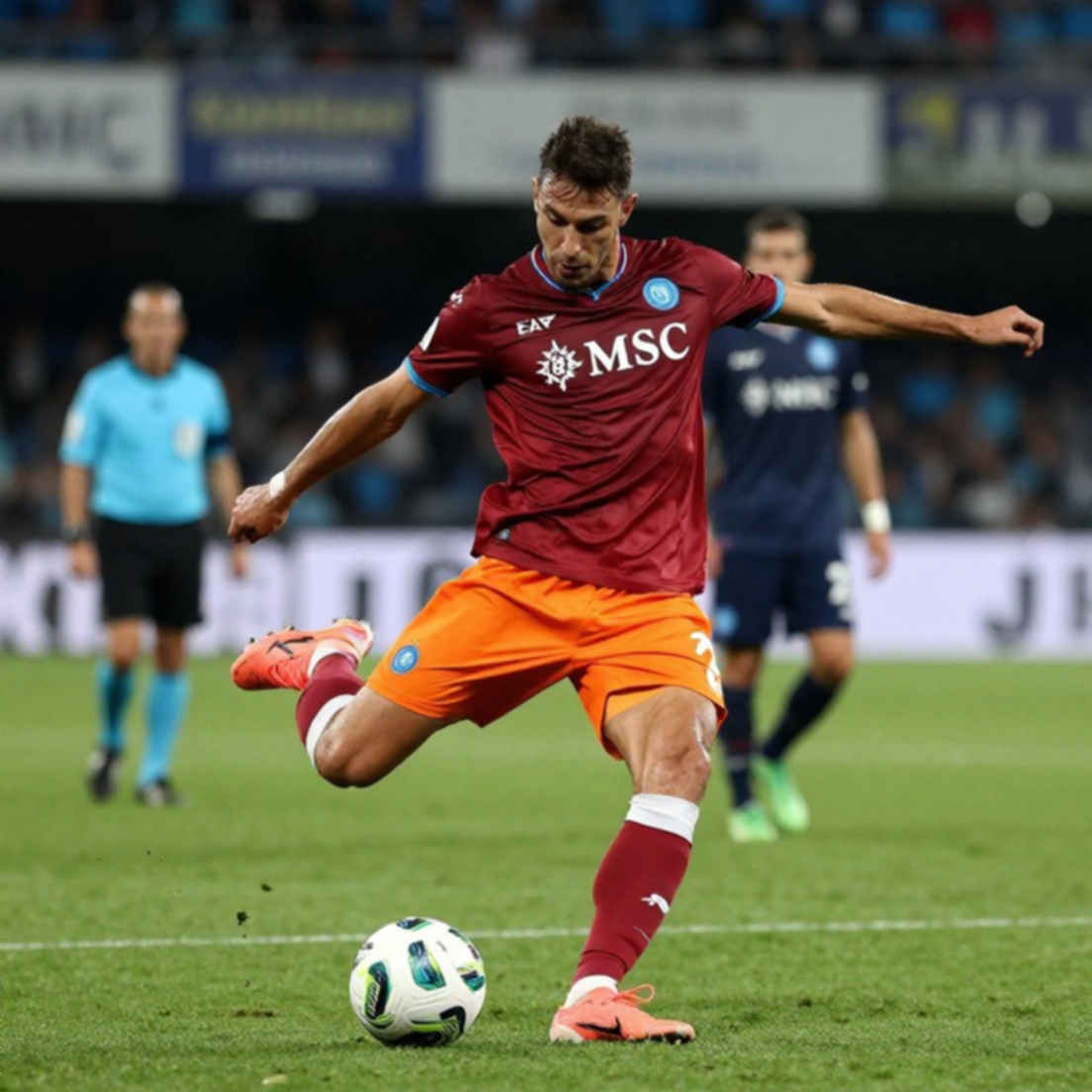
Phan Tuan Tai was the execution point of this plan. His cross produced the equaliser, confirming that the tactic was not mere whiteboard theory - it was genuinely the team's scoring channel. Popov named Tuan Tai personally in his post-match comments, a deliberate act of public credit.
But read closely how Popov framed it. He did not say "we played better". He said "we crossed twenty times". He was translating a match into a count. And in my world - a world where every action on the pitch can be counted - that is a far more honest way of speaking than grand declarations about fighting spirit.
Numbers never lie, but they are very good at telling half the truth. Twenty crosses is a fact. But the right question is not "how many crosses", but "how many of them created genuine danger". Without Opta or StatsBomb data at hand, I cannot answer. And that is precisely why I want to pause longer than usual, because in this industry people confuse a speaker's honesty with a number's precision.
One more thing about the timing of the goal. The equaliser came in the second half, after the home side had accumulated nearly all of its crosses. This is consistent with the "accumulation attempt" logic Popov described - it is a mechanism that works over time, not over an instant. But it is also a single sample. One match, once, is not enough to claim the tactic repeats in every context.
How Melbourne Victory defended
I want to give the opponent its own paragraph, because any analysis of an attacking tactic is meaningless without understanding what it is attacking.
Popov said Melbourne Victory were "physically strong" but "struggled in crossing situations". That sounds contradictory. But it is not logically contradictory. Physical strength is an individual matter. Struggling with crosses is an organisational matter - who marks whom, who covers which zone, who comes off their line and when. A physically imposing back line can still be loose in dividing responsibility. That is not a physical weakness, but a coordination weakness.
This is an important distinction in data analysis. When you look at a back line, you must separate two things: individual quality and organisational quality. Melbourne Victory may be strong in the first and weak in the second. If so, sustained crossing becomes a precise tool to exploit the organisational weakness - forcing the defence to make coordinated decisions under uncertainty.
I rewatched the second-half crosses to look for evidence of this hypothesis. I have no quantitative data at hand, but the naked eye can identify a pattern: Melbourne Victory defended more zonally than man-to-man, and when the ball was delivered into the contested area between the two centre-backs and the goalkeeper, they often left a small pocket of space. Those pockets were not large, but they recurred.
But I must be careful. This remains a coach's assertion, plus my subjective observation, not verified data. Popov has reasons to say this, and those reasons may include defending his own team. I rate the confidence of this observation as medium. A wrong model does not mean wrong data – it just means I have not read the right question yet. If I keep searching for a sophisticated tactical intent behind twenty crosses, I may be asking the wrong question.
Another hypothesis I cannot rule out: Melbourne Victory may have fielded a rotated side or been affected by the long-haul flight to Vietnam. If so, the effectiveness of the crossing tactic may be inflated by an opponent not at peak condition. This is the kind of variable that pure data never captures, and it is why I always say emotion and condition are data too.
The injury variable and a forced tactic
In most of my analytical models, injury is the worst-treated variable. People either ignore it or treat it as an excuse. But in this case, injury may be the variable that shapes the entire plan.
Popov admitted the team was missing "many important personnel". He did not name them, gave no recovery timeline, and did not say which positions were affected. That silence is itself information. A coach willing to talk about cross counts but not injury details is usually hiding a structural weakness, not just a few temporary absences.
If the injured players are creative midfielders - the ones who can deliver line-breaking passes - then switching to sustained crossing is not a tactical choice but a surrender to reality. You cross because you have no other way to get the ball into the box. A wrong model does not mean wrong data – it just means I have not read the right question yet. The right question is perhaps: "With the current squad, what is the best way to create even a single chance?" And the answer to that question, for many understaffed teams, is always crossing.
There is one detail I observed in the second half that I want to record. The The Cong - Viettel players did not cross randomly. They crossed in rhythms - three to four crosses in one sustained attacking phase, then a rest, then repeat. That is the signature of a trained plan, not of desperation. A desperate team crosses sporadically. A team with a plan crosses in clusters.
But that plan is still a single channel. And that leads me to the contrarian section of this piece.
Group E: A space that pure data cannot measure
What interests me more than this match is the shape of Group E, where a structure seems to be forming that pure data cannot capture.
FC Seoul, the group's highest-rated side, fielded eleven reserves in one match and paid the price. That is a very notable signal. It suggests Seoul may be prioritising the K-League over the ACL2, and a big club playing a rotated side always creates openings for the rest. In a balanced group, a big side weakening itself is a variable worth more than any statistic.
Persib Bandung, per Popov's observation, "spent a lot of money buying foreign players". This is a fact about resources, not quality. And here I want to restate a core principle of mine: The transfer market does not buy players – it buys the probability of the future. A club spending heavily on imports is buying opportunity, not guaranteed results. Import-heavy teams often take time to gel, and during that window they are more fragile than their price tag suggests.
For The Cong - Viettel, Group E is a space where every point carries great weight. A home draw keeps the team alive, but it also narrows the margin for error away from home. Popov said this draw made "the group situation more complicated". That is a roundabout but accurate way of speaking: he reads the group as a balanced space where unexpected results can overturn everything.
Empty stadiums in 2026 taught me: home advantage is not in the grass, it is in the ears. In this match, Hang Day Stadium had fans, and that noise may have been a real variable tipping toward the home side - especially in the second half, when the team kept crossing despite failure. Persistence under crowd pressure is a form of psychological resource, and it appears on no stat sheet.
There is one scheduling detail I consider more important than the match itself. After this game, the team enters the FIFA Days window, then returns to the V-League against Ha Tinh on October 9, before travelling to Indonesia to face Persib Bandung on October 14. That is a tightly compressed schedule, and it creates two parallel risks. The first is the risk of accumulated injury. The second is the "FIFA virus" - key players returning from national duty tired or injured.
I always treat the FIFA Days window as a double-edged variable. It gives the team recovery time, but it also takes away important players. For a team already thin through injury, losing more players during the international break is a risk no probability model fully quantifies.
Contrarian angle: The risk of a single channel
This is where I must say what perhaps nobody wants to hear right after a draw judged a success.
The accumulated-crossing tactic has one fatal weakness: it has only one channel. When I evaluate an attacking system, I always ask two questions. First, how does it create chances? Second, if that route is neutralised, what alternative remains?
For The Cong - Viettel in this match, the answer to the second question is nearly empty. There is no description of breaking through the centre, no significant central combination, no set-piece mentioned as an alternative channel. The entire attacking force is funnelled into the wide areas.
That means if the next opponent - Persib Bandung, for instance - prepares carefully to stop crosses, the team risks losing its primary creative channel. And in modern football, Asian teams generally treat cross defence as a basic part of defensive training. Once the opponent doubles the flanks and the keeper commands the box, the error-accumulation tactic loses most of its effectiveness.
Popov said his team needed more luck to win. I agree to some extent. But luck is a variable that cannot be coached. What can be coached is creating multiple parallel attacking channels. That is the work of the coming weeks.
There is one more thing I want to place on the table. Popov defining a home draw as "success" is a very shrewd expectation-management strategy. It shields the team from domestic media pressure - where continental results are scrutinised closely. But that definition has a cost. When you lower the standard, you are also telling your team that a point at home is enough. And in a balanced group like Group E, a point at home may not be enough.
I recall another time I had to recalibrate my entire model. It was when Denmark defended at the Euros, and I realised defence is not a sign of fear but an active act to re-establish control of tempo. A team defending in an organised way defends because it is reclaiming its breath, not because it has lost. I apply the same lens to Southeast Asian football, where weaker teams often defend not because they are being overrun, but because they are finding their own structure again.
But once you have found your breath, you must have a way to move forward. And that is the question The Cong - Viettel has left open.
Takeaway: Signals for the next round
On October 14, The Cong - Viettel travel to Persib Bandung. Popov himself called it "extremely difficult" - an opponent built on imported money, on Indonesian away soil, in a period when the squad is still wrestling with injuries and the dense schedule of both the V-League and the ACL2.
I will watch two things in that match. First, whether the team develops any attacking channel beyond crossing. Second, whether the injury cluster is partly resolved after the FIFA Days window. Those two variables will decide whether the Melbourne draw is a foundation or simply a pause before real difficulty arrives.
The draw against Melbourne Victory is not a tactical achievement. It is an acceptable result, earned by a process that is repeatable but fragile. And in football, fragility is always exposed at the exact moment you most need solidity.
But my model can be wrong. And if it is, I will read everything from the start.