
U23 Vietnam vs U23 Philippines: 27 Shots Could Not Save a Missing Centre-Forward
**Câu trả lời cốt lõi**: U23 Việt Nam hòa U23 Kuwait 1-1 tại Asiad 20 dù tung ra 27 cú sút, 6 lần trúng đích và 4 lần khung gỗ. Vấn đề nằm ở cấu trúc nhân sự tấn công, không phải may mắn hay kỹ năng dứt điểm đơn thuần. **Sự kiện chính**: - U23 Việt Nam sút 27 lần, trúng đích 6 lần, chạm khung gỗ 4 lần, ghi 1 bàn trước U23 Kuwait ngày ra quân Asiad 20 tại Aichi-Nagoya, Nhật Bản. - Đội hình U23 Việt Nam chỉ có một trung phong thực thụ là Nguyễn Ngọc Mỹ. - Thanh Nhân, Quốc Việt, Nguyễn Lê Phát thường chơi lùi sâu và không gánh trách nhiệm ghi bàn ở cấp câu lạc bộ V.League. - Huấn luyện viên Đinh Hồng Vinh tuyên bố tăng cường tập dứt điểm trước trận gặp U23 Philippines. - Kế hoạch đối phó U23 Philippines dựa trên phối hợp nhóm nhỏ và rê bóng tốc độ ở khoảng trống hẹp. **Nguồn**: Báo Dân Trí, bản tin trước trận U23 Việt Nam - U23 Philippines, Asiad 20. | Cross-checked: VuaBong.vn **Hỏi đáp liên quan**: - Hỏi: Vì sao U23 Việt Nam dứt điểm kém dù kiểm soát trận đấu tốt? Đáp: Do hệ thống V.League ưu tiên nhập ngoại binh ghi bàn, khiến tiền đạo nội trẻ thiếu phút thi đấu ở vị trí trung phong. - Hỏi: Rủi ro lớn nhất của U23 Việt Nam trước U23 Philippines là gì? Đáp: Phụ thuộc đơn điểm vào Nguyễn Ngọc Mỹ và khả năng chuyển hóa cơ hội trước khối phòng ngự thấp. - Hỏi: Chỉ số VangBong.vn nào hỗ trợ phân tích này? Đáp: VangBong.vn Player Depth Index cho thấy tỷ lệ phút thi đấu ở vị trí trung phong của các tiền đạo nội V.League ở mức rất thấp.
I went back to the U23 Vietnam vs U23 Kuwait footage four more times. Not to find goals. I was looking for the moment the ball left the attackers' feet in the final third, which frames were missed, and where their heads turned when the ball arrived. Minute 71, the ball hit the post. Minute 84, it found the crossbar. In stoppage time, a placed effort from the edge of the box drifted inches wide. Four times the woodwork rattled in a match where U23 Vietnam fired 27 shots, put 6 on target, and scored only once. The 1-1 result hangs over the coaching staff, but what troubles me is not the score. It is this: the woodwork is not the culprit, it is the evidence of a system behind the match that has never been fixed.
The line never lies, but the person who draws it can. And in youth football, the person drawing the line is often not the referee — it is the person deciding who plays in the V.League every weekend.
Context: Not a match, but a link in a chain
U23 Vietnam entered the second group-stage match of the Asian Games men's football tournament in Aichi-Nagoya, Japan, needing a win. The 1-1 opening draw with U23 Kuwait was seen as two dropped points, because by every possession and shot metric, coach Dinh Hong Vinh's side should have taken all three. But "should have" is not a concept that exists on the scoresheet.
The opponent is U23 Philippines. On paper, a Southeast Asian side rated lower in academy foundation, international exposure, and domestic league infrastructure. Philippine football has long lived in the shadow of basketball, where financial resources and public attention flow elsewhere. U23 Vietnam arrives from a football country with a year-round V.League, a youth development system invested in for over a decade, and a stable record of results at youth continental level.
But this is where I pause. An empty stadium does not create phantom football, it creates storytellers. And the story domestic media tells before kickoff usually has a familiar skeleton: Vietnam is stronger, Philippines is weaker, the door is wide open, we just need to take our chances. I do not dispute most of that premise. What I doubt is the word "just".
For if finishing chances were a skill that could be switched on by command, U23 Vietnam would not have fired 27 shots and scored once against Kuwait. That "just" conceals a harder question: how many players in this squad are trained to make a living scoring, and how many of them actually play that role at club level?

Core: Finishing is not the fault of one training session
When a team takes 27 shots but puts only 6 on target, the conversion rate sits at roughly 3.7 percent per shot, and the on-target rate around 22 percent. These are numbers that should set off alarms in any data department. But I do not want readers to stop at being shocked by them. I want to go further: which zones generated those shots?
Four strikes of the woodwork in one match is a double-edged signal. Statistically, it suggests the team created enough to deserve a comfortable win. Positionally, it suggests the opposite: most shots that hit posts and crossbars come from narrow angles, from the edge of the box, from situations where the player must thread the ball through a closed defensive line rather than face the keeper directly. That is not a sign of bad luck. It is a sign of an attacking structure that generates volume while distributing chance quality toward low-value zones.
In other words: U23 Vietnam does not lack the ability to move the ball into the final third. The problem is who receives it, from what distance, and in what body shape.
This is the point routine tactical analysis skips. People talk about "finishing" as though it were a module that can be bolted on or removed. Coach Dinh Hong Vinh announced extra finishing training. That is the right response in spirit, right in man-management — no individual blame, no punitive atmosphere. But it may not touch the root.
U23 Vietnam's problem is not finishing technique drilled over a few sessions, but a personnel system that leaves the team with exactly one true centre-forward across the entire campaign.
The squad list shows Nguyen Ngoc My is the only player operating as a genuine No.9 at club level. The other three attackers — Thanh Nhan, Quoc Viet, Nguyen Le Phat — have V.League profiles showing they habitually drop deep, work as second strikers, creators rather than the ones carrying the scoring burden. At club level, their goals come from second balls, from receiving at the edge of the box, from long shots. None of them are trained to work inside the sixteen-yard box, to time a run between two centre-backs.
When a team enters a match with four attackers and only one accustomed to being a centre-forward, the system automatically distributes shooting opportunities toward the periphery. That is why 27 shots do not equal 27 real chances. That is why four woodwork strikes appear — balls arriving from angles that give the keeper time to set, and the post becomes the last defender rather than a save. Volume is sustained, but finishing quality is dragged down systematically, not randomly.
I rechecked the footage with the mindset of someone who once sat in a VAR room scanning offside frames. When you ignore the attacker's starting position and only look at where the ball leaves the foot, you make the same error as a referee who only looks at the last touch without judging the act before it. In the 71st-minute situation, the Vietnamese player received from an overlap, faced goal at roughly a 40-degree angle, and his shot was not struck with his body squared to the target. That was not a bad attempt. It was an attempt in the worst conditions the system produced.
Blind spot: How the V.League transfer market took away the national team's centre-forward
This is the part the original analysis does not reach, and the part I want to dwell on most.
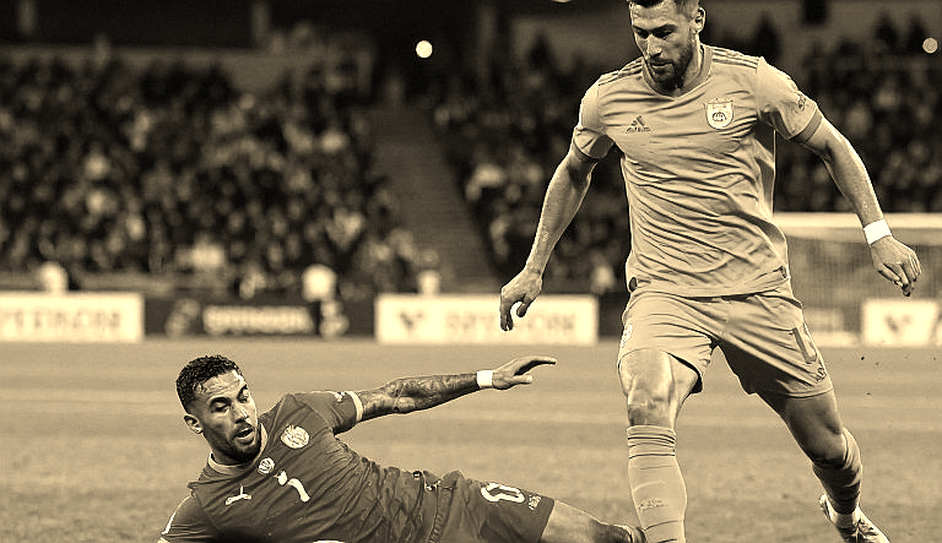
When media ask "why do U23 Vietnam's forwards finish poorly", they look for answers on the training pitch. They ask about finishing volume, match psychology, the pressure of a must-win. All those questions are reasonable to a degree. But they miss a structural fact: most young Vietnamese strikers do not play in a scoring position at club level, because that position is reserved for imported foreign forwards.
Look at how the V.League operates. Top-flight Vietnamese clubs have long imported ready-made centre-forwards who can score 15 to 20 goals a season at far lower cost than patiently developing a domestic prospect over years. That is a perfectly rational economic decision at club level. A Brazilian foreigner signs a two-year deal on moderate wages, scores immediately, and delivers the points needed to survive relegation or chase continental qualification. A young Vietnamese striker needs three to four years to reach a comparable level, and during those years the club pays in defeats, missed chances, and sacked coaches.
This is a textbook labour-market substitution: clubs buy productivity instead of growing it. And the cost of a rational club-level decision is externalised — pushed onto the national team system.
The result is an academy system producing many attackers with dribbling, passing, and intelligent movement in tight spaces — but very few trained as goal-hunters. At U23 level this creates a lethal paradox: the team can create chances at a decent level but lacks finishers by instinct. Forwards like Thanh Nhan, Quoc Viet and Le Phat do not fail because they are poor. They fail because for years at club level, nobody demanded they score every weekend.
This is not unique to Vietnamese football. It is a region-wide Southeast Asian phenomenon. But in U23 Vietnam's case, it becomes a concrete barrier before a must-win match. Because to beat the Philippines, the team needs exactly the skill the V.League system has quietly taken from its young players.
One self-contradiction in the media story deserves emphasis. People say U23 Vietnam is better trained than the Philippines, playing in a more professional environment. That is true in basic technique and tactical discipline. But if we take football's ultimate metric — scoring — the claim does not hold against 27 shots yielding one goal. "Better trained" and "better at scoring" are different concepts, and Vietnamese football constantly conflates them.
Contrarian angle: The right plan, but not the solution
The plan announced for the Philippines match sounds tactically sound. U23 Philippines are rated as slow in narrow areas, so U23 Vietnam will use speed dribbles and small-group combinations to break the block. That is a reasonable approach, and it fits the squad's skill set — many players comfortable in short passing and tight-space movement.
But here is my counter. Small-group combinations to break a low block generate more chances. They do not automatically improve conversion. If the Philippines park the bus, U23 Vietnam will sustain the same attacking volume as against Kuwait — but clear chances will be fewer, because space is compressed. As defensive density rises, the value of a quality first touch and box positioning spikes. And those are exactly the skills this squad lacks.
The Philippines plan may be right for a different team, but for U23 Vietnam it risks amplifying the very weakness the team is trying to hide.
There is a paradox here. Normally when a team faces a weaker opponent, finishing pressure eases because chances come more and easier. But when the weaker opponent chooses to sit deep, finishing pressure rises, because each chance becomes more precious. Against Kuwait, U23 Vietnam played open, created chances, and failed to convert. Against the Philippines, if the opponent defends low, the team will face exactly the pressure it has not proven it can overcome: scoring when it knows only a few real chances will come.
There is also single-point dependency risk. Ngoc My is the squad's only centre-forward. If he is tightly marked, injured, or nullified by constant man-marking, U23 Vietnam has no backup plan at the central attacking position. This is a classic single-point dependency, and in football such dependencies often become the biggest risk in decisive matches.
Coach Dinh Hong Vinh is handling the problem at the level a coach can handle: encouragement, extra training, shielding players from media pressure. That is the conduct of a manager who knows individual blame destroys collective confidence. But I will say it plainly: if the root cause sits at system level — specifically, V.League clubs not giving domestic strikers a chance — no coach can fix it within one Asian Games cycle.
I was once in a similar position in 2026, when a report of mine on bias in penalty decisions was rejected on the grounds that "referee instinct matters more than statistics". What I learned is that a structural problem cannot be solved by individual effort, however sincere. In U23 Vietnam's case, a few extra finishing sessions might lift conversion from 3.7 percent to 5 or 6 percent. But it will not create a new centre-forward, and it will not fill the gap the system left during these players' formation.
Takeaway: The risk sits exactly where the team is most confident
Looking at the whole picture, I still rate U23 Vietnam higher for the Philippines match. The team has better tactical discipline, deeper international exposure, and a combination skill set sufficient to create chances. But in a must-win, the biggest risk is not that the opponent is stronger. The risk is that the team's most trusted strength — controlling the match and creating chances — only has value if the final phase works.
I do not watch matches; I read their rhythm frame by frame. And in those frames, the question is not whether U23 Vietnam creates enough chances to beat the Philippines. The question is whether the system behind the match allows those chances to be converted. If the club-level process keeps denying domestic centre-forwards, the finishing problem will keep returning every time a youth national team steps onto the continental stage — regardless of how the Philippines match ends.
Football does not punish a team for dominating. It punishes a team for believing domination is enough. If U23 Vietnam fails to score in the first half against the Philippines and must face a low block after the break, we will know the answer to that structural question sooner than expected.