
Trang chủTable TennisEarly Exit in Macao: India’s Contrarian Table Tennis Move before the 2026 Asian Games
Early Exit in Macao: India’s Contrarian Table Tennis Move before the 2026 Asian Games
Câu trả lời chính: Tại WTT Champions Macao, Manush Shah và Manav Thakkar của Ấn Độ cùng dừng bước ở vòng một đơn nam, lần lượt thua Anton Kallberg 0-3 và Alexis Lebrun 1-3. Sự kiện chính: - Manush Shah thua Anton Kallberg 0-3 (10-12, 5-11, 6-11) tại WTT Champions Macao. - Manav Thakkar thua Alexis Lebrun 1-3 (12-14, 4-11, 11-9, 3-11); Alexis Lebrun là hạt giống số 6. - Manav Thakkar thua Harimoto Tomokazu tại Europe Smash; Manush Shah thua Denis Ivonin tại WTT Contender Almaty. - Cặp đôi này đang xếp hạng 3 thế giới ở nội dung đôi nam và vẫn có tên dự Asian Games 2026 tại Aichi-Nagoya. Nguồn: Stage-2 Deep Professional Analysis (không xác định đơn vị phát hành), tháng 9 năm 2026. Hỏi nhanh: - Hỏi: Ấn Độ có đặt mục tiêu huy chương đôi nam tại Asian Games 2026 không? Đáp: Có, vì Manush Shah và Manav Thakkar là cặp đôi nam số 3 thế giới. - Hỏi: Chuỗi thua đơn có làm mất suất của họ không? Đáp: Không, danh sách dự Asian Games 2026 của Ấn Độ đã có hai tay vợt này.
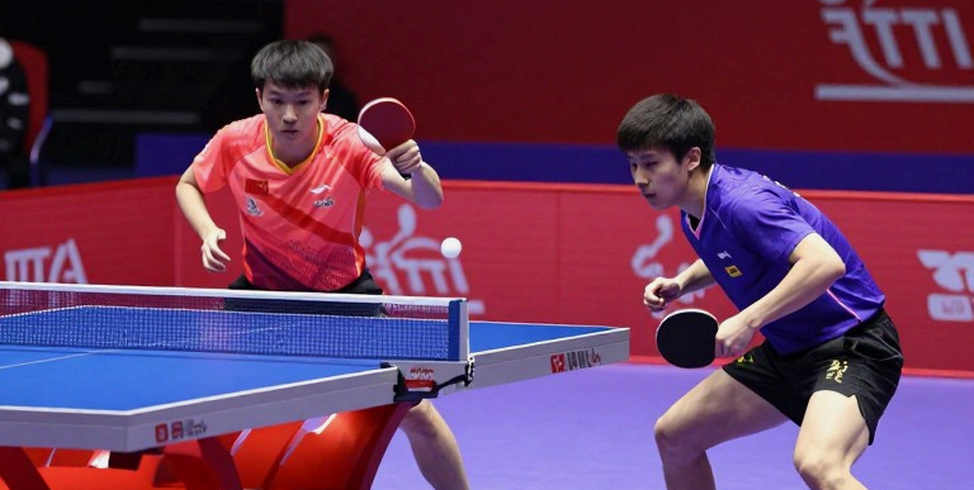
When the final ball clipped the edge of the table and bounced out, Manav Thakkar stood still. He had just lost the fourth game 3-11 to Alexis Lebrun at WTT Champions Macao. Fifteen minutes earlier, he had won the third game 11-9, sparking a sliver of hope against the No. 6 seed from France. At the other table, Manush Shah left after a 0-3 defeat to Anton Kallberg, despite fighting back to 10-12 in the first game. The two players once formed the world No. 3 men’s doubles pair. As singles players, however, they had just exited a major event in the opening round. Before the 2026 Asian Games in Aichi-Nagoya, the crucial question is no longer who defeated them, but whether they are paying the price of a deliberate strategy or slowly losing themselves.
These were not isolated failures. A few days earlier, Manav Thakkar lost to Harimoto Tomokazu at Europe Smash. Manush Shah also lost to Denis Ivonin at WTT Contender Almaty. Their combined recent international singles record shows four losses against four opponents from three different table tennis schools. No win was registered. Meanwhile, Japan will enjoy home advantage at the Asian Games, China remains dominant, and South Korea as well as Chinese Taipei have deeper squads. An Indian team with the world No. 3 men’s doubles pair but fragile singles form is walking into a maze.
Specialists often talk about the rise of Indian table tennis when they mention Shah and Thakkar. They are young, technically balanced, and ranked No. 3 in men’s doubles. But modern table tennis rarely rewards a doubles-only team if the same players cannot maintain depth in singles. Strong nations use singles to sharpen reflexes and clutch-point bravery, then convert those qualities into doubles success. India appears to be doing the opposite: investing in doubles, treating WTT singles events as public training, and still entering Aichi-Nagoya as a doubles seed with a worrying singles losing streak.
A closer look at the score lines shows a more nuanced picture. Manush Shah lost the first game to Kallberg 10-12, then fell 5-11 and 6-11. Manav Thakkar lost the opening game 12-14, won the third 11-9, but managed only 4-11 and 3-11 in the other two games. Alexis Lebrun is the sixth seed. Harimoto is one of Asia’s best. Kallberg represents Sweden’s resurgence. These are not easy opponents for players outside the top 20. Calling this a collapse is unfair. Yet it is equally unfair to pretend that everything is fine. The line between losing to a stronger opponent and losing because you abandoned yourself is thin.
The blind spot lies in the separation between two faces of the same players. If we look only at singles results, Shah and Thakkar look fragile: early exits, losses in tight games, no turning point. But when paired together, they are the world No. 3 doubles pair, a rare asset outside China. No team can invest equally in two demanding goals with the same players without paying a price. They are choosing doubles. The losing streak at WTT Champions Macao may be the price of that choice. People may call them deserters of the singles dream, but I have been called harsher names. They called me a traitor back in 2026, but I was only seeing further than an old teammate. For India, the vision should be a team medal, not a first-round victory in Macao.
The second issue is preparation. Instead of entering a closed training camp, both players chose a dense match schedule. Manush went from Almaty to Macao. Manav went from Europe Smash straight to Macao. The theory is to keep the feel of the ball. In practice, continuous competition without corrective training turns small flaws into habits. Every match followed the same pattern: staying close until ten points, losing the key moments, then starting the next game with fading composure. 10-12, 12-14, 11-9, then 3-11. This is not a sign of weak stamina. It is a sign of missing a simple backup plan that can be executed during a twenty-second break.
I cannot watch these matches without remembering a night in Kazan in 2026, when Kylian Mbappe tore through Argentina’s defence with sheer speed. That night in Kazan did not kill old football; it exposed those who were too slow. Indian table tennis is facing its own version of that moment. They are not slow in terms of hand technique. They are slow in using information, and slow in admitting that singles results are a mirror of real level, even if they do not want to look into it. While Europe and Asia have moved toward winning the initiative from the third ball, Shah and Thakkar still let matches drift according to emotion.
But let me argue against myself. These defeats could be good news. The Asian Games does not reward players who win many group-stage matches. It rewards those who survive exactly seven matches in one week. If India defines its goal as men’s doubles and men’s team events, losing early in singles reduces expectation, gives more time for scouting, and avoids the psychological burden of having to win a warm-up event. They are already a doubles seed. They do not need to prove that again. The real cost is that if they fail in doubles, this singles streak will be used against them. If they succeed, nobody will remember Macao.
I could be wrong for judging them too harshly. Perhaps the coaching staff is deliberately holding back, saving energy for the right moment in Japan. But such a gamble only works if confidence remains intact. In Macao, I did not see that confidence. I saw two players torn between two goals. In doubles, they are world No. 3. In singles, they lose even the opening matches that should build momentum. If they do not resolve that tension, Aichi-Nagoya will not forgive them.
I am old, but I am fast enough to understand that the slow will disappear. The Indian team has less than a year to choose between deep doubles specialisation and rebalancing the singles game. If they still allow early games to slip away in chasing mode, the medal will remain an illusion. If they use the Macao losses to adjust more quickly, they will not need anyone to call them early arrivals. The scoreboard will say it by itself.

Cầu thủ liên quan
Bài đề xuất
Hanoi T&T vs Binh Duong: Women's Table Tennis Derby Reshaping Vietnam's Sports Landscape2026-09-13
Vietnamese Youth Table Tennis: Reading a Generation Through Space-Penetration Metrics2026-09-15
England Hopes U11: Nine Wins, One Title Decided by a Single Head-to-Head Match2026-09-15
Vietnamese Table Tennis: When Data Analysis Is Only a Blank Space2026-09-09
WTT Champions Macao 2026: Anna Hursey Meets Miwa Harimoto in the Last 16 After a Straight-Games 3-0 Win2026-09-14
Vietnamese table tennis talent Nguyen Duc Hieu shines at national U15 championship2026-09-09
Table Tennis England Annual Report 2026/26: Strategic Signals from a Host Year2026-09-11