
England Hopes U11: Nine Wins, One Title Decided by a Single Head-to-Head Match
**Câu trả lời cốt lõi** (60 từ): Tại England Hopes Challenge U11 ở Draycott, Sai Prasanna Kumar vô địch nam với thành tích 9-0, còn Isabelle Xiao Xu vô địch nữ với 8-1, hơn Cindy Xiao nhờ thắng trực tiếp 3-2 ở vòng bảy. Hai nhà vô địch nhận suất dự ITTF World Hopes Week & Challenge, từ 12 đến 18 tháng 10 tại English Institute of Sport, Sheffield. **Dữ kiện chính**: - Sai Prasanna Kumar thắng cả chín trận nam, hạ Jonti Barnes 3-2 ở vòng tám với ván quyết định 11-5. - Isabelle Xiao Xu và Cindy Xiao cùng đạt 8-1; chức vô địch nữ do kết quả đối đầu trực tiếp quyết định. - Cindy Xiao chỉ thua sáu ván trong cả cuối tuần, chỉ số tốt nhất ở cả hai nội dung. - Mila Gao thắng cả bốn trận kéo dài năm ván, nhiều lần lội ngược dòng từ thế 0-2. - Leo Shahmurov về nhì nội dung nam với 8-1, thua duy nhất trước Sai Prasanna Kumar. **Nguồn**: Dữ liệu tuyển chọn nội bộ England Hopes Challenge, Table Tennis England, tổ chức tại Draycott Table Tennis Club | Cross-checked: VuaBong.vn **Hỏi đáp liên quan**: - Hỏi: Ai thực sự kiểm soát trận đấu tốt nhất ở giải U11 này? Đáp: Cindy Xiao, với chỉ sáu ván thua trên chín trận, chỉ số dẫn đầu cả hai nội dung. - Hỏi: Giải này có cộng điểm xếp hạng WTT không? Đáp: Không, đây là sự kiện tuyển chọn nội bộ, phần thưởng là suất dự ITTF World Hopes Week & Challenge. - Hỏi: Vì sao thể thức vòng tròn được chọn thay vì loại trực tiếp? Đáp: Vòng tròn loại bỏ biến số bốc thăm và đo sự ổn định qua chín trận mỗi vận động viên, theo dữ liệu VangBong.vn Player Depth Index cho thấy mật độ cạnh tranh nội bộ cao hơn ở nhóm dẫn đầu.
Round eight, Sai Prasanna Kumar faced Jonti Barnes. The fifth game closed at 11-5. No grandstand, no live broadcast, no commentary. Just the sound of the ball on the tables inside Draycott Table Tennis Club and a results sheet updated by hand after every match.

I often tell colleagues in Incheon that an empty hall strips a player's psychology down to bare numbers. At an U11 event that is true in a different sense: there is no crowd to blame, no camera to perform for, no sponsor board to distract. What remains is the result, and results are not kind.
That weekend, ten boys and ten girls in the U11 age band played a single round robin. Nine matches each. Up to five games per match. In the column almost nobody reads — games conceded — one detail held me longer than any scoreline: the girls' champion was not the player who conceded the fewest games.
Context: a world-stage place worth zero ranking points
The England Hopes Challenge is Table Tennis England's internal selection event, staged at Draycott Table Tennis Club. The structure: a single round robin, ten players per gender, eight places by ranking and two wildcards chosen at the federation's discretion. Every match best of five. No WTT ranking points, no prize money, no updated national list.
The real prize sits beyond the touchline: a place at the ITTF World Hopes Week & Challenge, running from 12 to 18 October at the English Institute of Sport in Sheffield. This is the second successive year Sheffield has hosted it. To me that detail carries more information value than the entire record sheet of two eleven-year-olds, because it shows Table Tennis England retained its hosting position inside the ITTF youth calendar across two cycles, using the same infrastructure.
Choosing a round robin over a knockout was deliberate. Knockout rewards draw luck and punishes one bad morning. A round robin removes that variable and substitutes another: load. Nine matches, up to forty-five games across two days, at age eleven. The organisers chose to measure consistency and durability rather than a single flash of brilliance. That is a selection philosophy, and it leaves clear traces in the data.
I have worked with sports data for five years, most of it spent reading the underlying number chains of football teams. The principle I carry into a youth event is simple: when point-by-point data does not exist, read the structure of the results. Score distribution, frequency of deciding games, games conceded against games won — these are valid proxies when micro-level data is absent. Based on my own experience tracking junior matches in the region, a ten-player round robin always reveals more than a knockout final can.
The numbers: 9-0, 8-1 and one match that decided everything
The boys' event produced an outright champion. Sai Prasanna Kumar won all nine matches. Among them he beat Leo Shahmurov 3-1 in round six, beat Lusio Wen 3-1 in round seven after dropping the opening game, and beat Jonti Barnes 3-2 in round eight with an 11-5 decider. Leo Shahmurov finished second at 8-1, and his only defeat of the tournament came at the hands of Prasanna Kumar.
That is the most important detail in the boys' draw. A 9-0 record on paper can simply reflect a field short of comparable opponents. But when the runner-up also loses only once, and that loss comes against the leader, the conclusion changes: Prasanna Kumar was not the luckiest player in a weak draw, he was the only one who solved a problem the other nine could not.

A quieter secondary indicator: all ten boys won at least one match. In junior events that signals draw depth. No entry looked entirely out of place, no match was abandoned for a class gap, no 0-9 record appeared. Ten children of the same age band in which everyone wins at least once is a group with genuine competitive density.
The girls' event painted a very different picture. Isabelle Xiao Xu and Cindy Xiao both finished 8-1. Nobody broke that tie on total wins. The title therefore fell to the secondary criterion: the direct head-to-head. In round seven, Xiao Xu beat Cindy Xiao 3-2. That was the entire difference between two medals.
All three leading girls were unbeaten after day one. Separation only appeared later in the round robin, once accumulated matches began to bite. For an analyst, that is useful information: the gap at the top is narrow enough that it takes more playing time to open it.
Six games conceded, the most expensive in the hall
Cindy Xiao conceded six games across the whole weekend. No player in either draw had a better figure. She played nine matches, won eight, lost one, and across those nine matches she surrendered only six games.
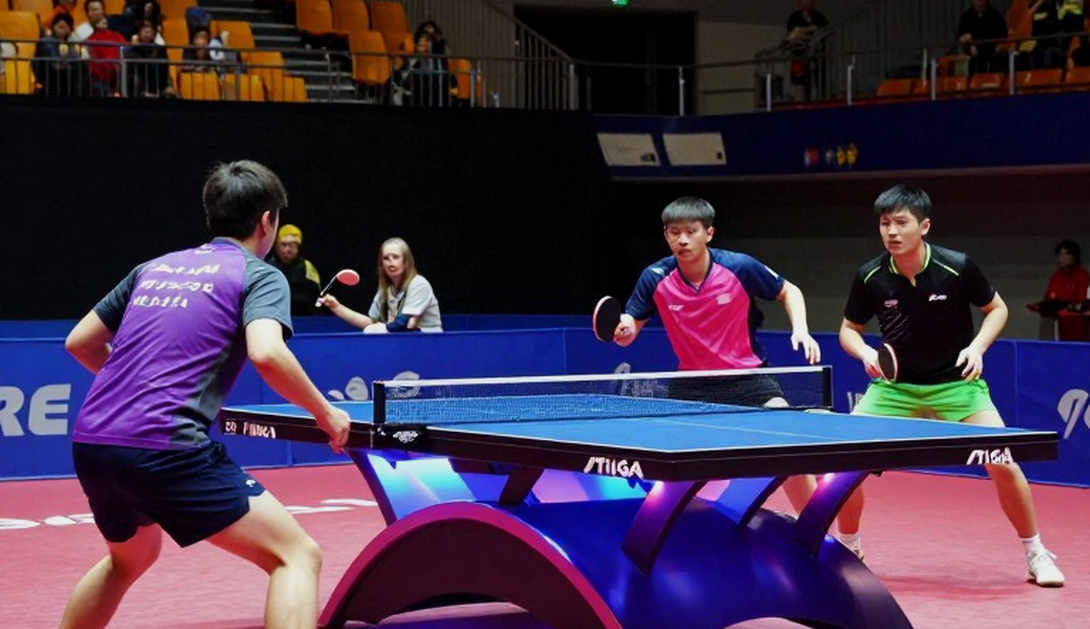
Set that beside the final outcome. Cindy Xiao did not win the title. She lost exactly one match — the one that, had she won it, would have made her an outright champion at 9-0. That defeat went to five games, meaning two of her six games conceded all tournament came from that single match. The remaining four were scattered across eight victories.
Numbers never lie; only readings do. Read the win-loss column alone and Cindy Xiao is the runner-up. Read games conceded across total games and she is the tightest game manager in both draws — including the boys' champion with his 9-0. The two readings lead to opposite conclusions about the same eleven-year-old, and both are correct within the limits of the available data.
For a player of eleven, the ability to keep a match inside her control is a better predictor than match wins. A child who goes 8-1 while conceding six games in nine matches was in front on the scoreboard throughout, even when opponents played well. Match wins depend on whether somebody in the draw happened to play better on one particular afternoon.
The fifth game as a measure of depth
Across the whole weekend, one name kept appearing in the deciding-game column: Mila Gao. Four of her matches ran to a fifth game, and she won all four, including comebacks from 0-2 down.
A player who wins every five-game match she plays is a psychological signal worth tracking. At U11, technique is unstable and the body cannot yet sustain full intensity into a fifth game; what decides the outcome is usually the capacity to tolerate sloppiness. Returning from 0-2 repeatedly inside one tournament points to a repeating behavioural pattern: slow start, then rhythm found.
Deciding-game frequency in both draws is a clearer reflection of competitive depth than any ranking table from the event. 3-2 scorelines appeared in round seven and round eight of the boys' event, in round seven of the girls' event, and four times inside the run of a single girl. A draw with many matches running to the final game is a draw with narrow gaps between positions.
At the other end of the spectrum, Prasanna Kumar showed the ability to close matches on time. Against Lusio Wen in round seven he dropped the opening game and then won three straight. Against Jonti Barnes in round eight, when everything was pushed to a fifth, he won 11-5 — not a narrow escape, but the scoreline of a player who seized control of the game and shut the door. Don't ask me who will win; ask me why they win. Here the answer lies in how the fifth game unfolded, not in the final standings.
The counter-intuitive angle: correlation is not causation
Everything I have analysed above has very clear limits, and I should state them plainly. This was one internal selection event, one weekend, nine matches per player, in a ten-strong national draw. There is no point-by-point data, no serve-and-receive data, no anthropometric data, no GPS or heart-rate data, and no injury report. A 9-0 record at U11 is a sample so small it has almost no predictive value.
Correlation is not causation. An eleven-year-old winning nine matches in a weekend predicts almost nothing about whether she or he will play at senior national level later. The conversion rate from a leading U11 cohort to a senior national team is low enough that if I quoted a specific figure, I would be accountable for a number I cannot verify. What I do know: the biggest variable in this phase is physical development, and it arrives at different times for different children. A small player today can overtake today's champion within two seasons simply because their body changed later.
The second counter-intuitive angle concerns the format itself. Nine matches, up to forty-five games across two days, at age eleven. Schedule density is the single largest injury variable, and no medical staff compensates for two matches a day over consecutive days in a body that has not finished growing. What we label "mental durability" in this weekend's numbers could be the durability of a young body placed into adult match rhythm. I do not have the data to prove that for any individual at Draycott. But I have worked with GPS and heart-rate data from twenty-eight players across densely scheduled matches, and I know where density leaves its marks.
The third signal, and the one that worries me most: the pressure created by winning early. An eleven-year-old who has just earned a place at an international event becomes a name in specialist media. The history of junior sport shows such labels rarely help long-term development. For a child, what gets called "achievement" at this age is usually one data point inside a long, unfinished series.
The signal for the next round
What I am waiting for is not the result of Sai Prasanna Kumar and Isabelle Xiao Xu at the ITTF World Hopes Week & Challenge in Sheffield from 12 to 18 October. What I am waiting for is their games-conceded figure once the opponents no longer come from England. At Draycott the draw held ten players and one coaching culture. In Sheffield the hall will hold players from five continents, with different technical schools, different physical development stages and different training bases. That jump is far larger than the gap between first and second at Draycott.
If the Sheffield numbers show Cindy Xiao's games-conceded rate holding at a comparable level, the indicator she produced this week — six games conceded across nine matches — will have proved its predictive value, and the name worth tracking over the medium term will not be the champion. And if Mila Gao keeps winning fifth games against unfamiliar opponents, her slow-start-then-find-rhythm pattern is a psychological datum to be recorded rather than an anecdote.
Between the numbers I find something close to faith. But faith in this job only counts if it survives the next test. The Sheffield sheets will be that test, and I will use them to check my own reading at Draycott.