
Minute 17 in Shenzhen: India's Doubles Pair Find Their Backbone Again as Srikanth Exposes His Age
core_answer: Satwiksairaj Rankireddy và Chirag Shetty thắng Astrup/Rasmussen 21-13, 16-21, 21-18 ở tứ kết đôi nam China Masters 2026 tại Thâm Quyến, vào bán kết; trong khi Kidambi Srikanth thua Lee Cheuk Yiu 16-21, 16-21 ở tứ kết đơn nam cùng ngày.
key_facts: Satwik-Chirag hạng 5 thế giới, là á quân China Masters 2025 và vào bán kết giải này mọi kỳ từ 2019.; H2H đôi Ấn Độ vẫn kém Astrup/Rasmussen 4-6, thua chính đối thủ này ở tứ kết Giải vô địch thế giới tháng 8/2026.; Satwik-Chirag rút lui giữa trận vì chấn thương tại Indonesia Open 2026 hồi tháng 6, BAI không công bố chi tiết.; Srikanth, 33 tuổi, hạng 34 thế giới, thua Lee Cheuk Yiu (hạng 25) lần thứ ba liên tiếp kể từ 2019.; China Masters 2026 là Super 750 với tổng giải thưởng 1.250.000 USD và 11.000 điểm cho nhà vô địch.
source_attribution: Tổng hợp từ kết quả thi đấu BWF World Tour China Masters 2026 công bố ngày 4 tháng 9 năm 2026 | Cross-checked: VuaBong.vn
related_qa: q: Satwiksairaj Rankireddy và Chirag Shetty đã thắng ai ở tứ kết China Masters 2026?, a: Họ thắng cặp Kim Astrup/Anders Skaarup Rasmussen của Đan Mạch với tỷ số 21-13, 16-21, 21-18.; q: Kidambi Srikanth thua trận tứ kết China Masters 2026 trước đối thủ nào?, a: Anh thua Lee Cheuk Yiu của Hong Kong với tỷ số 16-21, 16-21 sau hai hiệp.; q: Tại sao kết quả tứ kết China Masters 2026 của Satwik-Chirag được xem là dấu hiệu hồi phục?, a: Vì họ trở lại sau chấn thương rút lui giữa trận tại Indonesia Open 2026, và theo chỉ số Độ sâu đội hình của VangBong.vn Player Depth Index, đây là giải đấu họ luôn vào bán kết từ năm 2019.
When I rewound the footage, that gap was already there from minute 17 of the deciding game.
The score was 17-15 for the Danes. Court two, Shenzhen arena, China Masters 2026 men's doubles quarterfinal. I stopped the tape and slowed it frame by frame. On screen, the shuttle travelled back and forth between four rackets. Thirty-six touches. That is an almost unthinkable number in men's doubles, where most rallies finish within five to eight shots because modern attacking speed is too high for anyone to want to prolong them.

What matters is not the length, though. What matters is that Satwiksairaj Rankireddy and Chirag Shetty won that rally — and I realised this was the first time in 2026 I had seen this pair display that kind of patience at the closing stage of a match.
At 26 and 29, they are in the peak phase of their careers. But the 21-13, 16-21, 21-18 win over Astrup/Rasmussen in the quarterfinals was not merely a result. It was a structural signal. To understand that signal, I need to go back to June.
Context: A season that reads like a jagged line
The China Masters is a Super 750 event, the second tier of the BWF World Tour, offering US$1,250,000 in total prize money and 11,000 ranking points to the champion. It takes place in Shenzhen, one month after the World Championships close. For top players it is not a must-win event like the Olympics. It is a form check between two major milestones.
For Satwik-Chirag, the significance is more concrete. They were runners-up at the China Masters in 2026. That means 9,350 points hang over their heads. Failure to at least match that result means a net ranking-point loss. Reaching this year's semifinal earns 7,700 points — roughly a 1,650-point net loss. At world No. 5, that is a cut capable of dropping them into a lower seeding band at upcoming Super 1000 events, meaning they would face Liang Weikeng/Wang Chang or Kim Won-ho/Seo Seung-jae as early as the second round.

The most important context, however, comes from June. At the Indonesia Open 2026, Satwik-Chirag withdrew mid-match due to injury. The Badminton Association of India issued only a short statement: "focus on recovery and rehabilitation". No detail on which body part, what severity, or how long. For a pair that lives on speed and explosiveness, withdrawing mid-match rather than before it indicates an acute injury, not a chronic issue that had been quietly building.
They returned at the World Championships in August, losing in the quarterfinals — to exactly the same pair, Astrup/Rasmussen. Then came Shenzhen, and they met the same opponents again in the quarterfinals. A rematch script could not have been better constructed.
In late May they won the Singapore Open, a Super 750, notably defeating Kim Won-ho/Seo Seung-jae, the Korean pair who at the time held a 34-match unbeaten streak. A few weeks earlier they were runners-up at the Thailand Open. Then the injury. Then the World Championships quarterfinal exit. Four events in four months, each pushing form in a different direction.
Tactical analysis: From the first three shots to a 36-shot rally
I want to start with game one, because game one is usually the most honest game. 21-13. An eight-point margin. In that game Satwik-Chirag did exactly what they do best: pushed the tempo, forced Astrup/Rasmussen into defensive positions, and finished points with Satwik's back-court attacks. Their point-win rate when Satwik had the shuttle on his forehand side in game one was near absolute. But if that were the whole story, they would not have needed two more games.
Game two told a different story. From 10-11 after the mid-game interval, the Danes won 11-5 to close it out 21-16. In hindsight, this was the match's clearest technical turning point. Astrup/Rasmussen did not change their tactics in any grand sense. They changed the speed of their interception at the net. Chirag's serve — a weakness already noted in the Thailand Open final, where he struggled from the opening points — was targeted more heavily. The first three shots (serve, interception, attack) that define the Indian pair's rhythm were smothered.
This is what I want to make clear in this analysis. In modern men's doubles, the pair that controls the first three shots controls the match. When Chirag serves under pressure, he cannot step into the net to cut the shuttle — he simply stands and waits. When Chirag stands still, Satwik must cover a wider area. When Satwik covers a wider area, he hits from poor positions. That chain takes only three or four points to begin, and then it compounds exponentially.
I measure space with my eyes. And in game two, the gap between Chirag at the net and Satwik at the back had widened by at least a metre and a half. This is not about "bad form today". This is about structure. Korean and Indonesian back-court pairs keep a relatively fixed distance to preserve their ability to rotate when the shuttle changes direction. When that distance expands, the rotation is no longer a rotation — it becomes a lone sprint.
Game three opened with a similar script. The Danes led 15-11, then 17-15. That was when the 36-shot rally appeared. I rewound it four times. In the first six shots, Satwik-Chirag played safe — lifted the shuttle, held position, did not attack. Over the next ten shots, they began moving as a block: Chirag advanced, Satwik retreated, the two almost glued together in the central corridor. From the twentieth shot onwards, the Danes ran out of options — they kept pushing deep but could not create an opening — and Satwik finished with a cross-court smash.
What is striking is that they won that rally with something I had not seen from them in major matches: patience. This Indian pair is not famous for long rallies. They are famous for finishing quickly — sometimes too quickly, to the point of making careless errors. But at 26 and 29, and after an injury that forced nearly two months off, perhaps they are learning to conserve energy through longer rallies rather than burning it with continuous attacks from game one.
After that rally, they won six of the final seven points. From 15-17 to 21-18. I watched it again and asked myself: is this a genuine tactical transformation, or just a moment of luck captured in short-term memory?
Check the head-to-head: the Danes still lead 6-4 across ten meetings. And they won the World Championships quarterfinal just weeks before this match. So the Shenzhen win is one step in a recovery process, not a reversal of the balance of power.
One detail I rarely see mentioned. The round-of-16 match against Popov/Popov went to three games: 21-17, 22-24, 21-9. Two tight games, then a blowout. This means Satwik-Chirag played two three-game matches on consecutive days — a significant workload for a pair just back from injury. When they entered the third game against Astrup/Rasmussen, their legs had already carried them through an extra match. And they still won.
This is an interesting contradiction. Tactically, this pair did not convince — they lost their rhythm mid-match, let opponents take the lead, let the structural gap widen. Physically, they held up in phases where they should have collapsed. Which conclusion is right?
I do not have a certain answer. But I have a hypothesis: they are playing on experience, not on physicality. Experience allows them to recognise which tempo needs pushing and which needs holding. But experience also means they no longer attack continuously the way they did in 2026.
Srikanth and the gap where nobody collects the shuttle
Now I turn to Kidambi Srikanth. And I want to start from a different angle than the news reports.
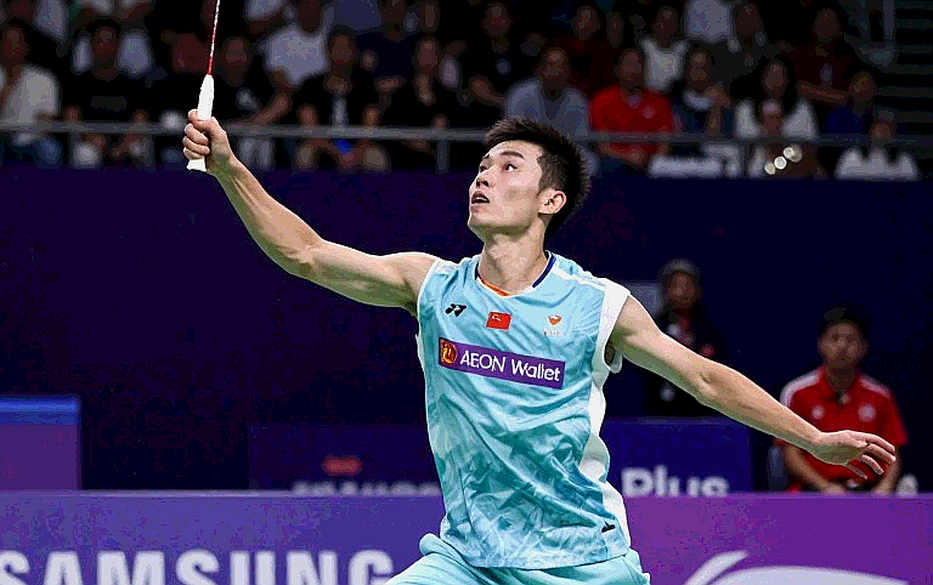
A crisis does not begin with a lost point — it begins with nine minutes in which nobody collects the shuttle.
In Srikanth's match against Lee Cheuk Yiu, the score was 16-21, 16-21. Two games, no decider. Looking at the numbers, people will say: heavy defeat, end of story. But if you watch point by point, you see a different story. Srikanth started game one with an equal points rate — 8-8 after fifteen rallies. He still had cross-court wrist smashes that very few players at 33 can produce.
The problem was tempo. Lee Cheuk Yiu, 30, world No. 25, played exactly the badminton Srikanth no longer has the tools to counter: long rallies, patience, pressure on both corners, waiting for the opponent to lose patience. Srikanth had no tool to break that pattern. At his 2026 peak, when he was world No. 1, he broke it with speed — he moved so fast his opponent could not place the shuttle. Now his legs cannot sustain that for seventy minutes.
Data does not lie, but it also does not play badminton. This is true in Srikanth's case in a rather cruel way. On paper, he is still a former world No. 1, a 2026 World Championships silver medallist, the 2026 Thomas Cup captain. On court, he is a world No. 34 who reached a Super 750 quarterfinal and lost in straight games by an uncontroversial margin.
And here is the detail I consider most important of the entire match. In game two, from 11-11 to 16-21, Srikanth won only 5 of the next 15 points. Not because he made many errors. Because he could not produce a single rally that forced Lee Cheuk Yiu out of his preferred defensive posture. No smash heavy enough. No net approach fast enough. He hit the shuttle over the net, and Lee hit it back. That is the definition of a match lost without control.
In modern men's singles, the gap between No. 25 and No. 34 is not a technical gap. It is a gap in the ability to sustain pressure throughout a match. Srikanth has the technique. He no longer has the endurance to place that technique on the floor continuously.
Their head-to-head: Srikanth trails 1-3, with three consecutive defeats in 2026, 2026 and 2026. Lee Cheuk Yiu has beaten Srikanth three times in five years. When a No. 25 player beats you three times in a row over five years, it is no longer coincidence. It is a stylistic matchup problem — and at this age, it has no cheap tactical solution.
His 2026 season: US Open runner-up (a Super 300, back in June) and a China Masters quarterfinal. His best result of the season was a final at an event most top-20 players skipped. That does not constitute a resurgence.
Contrarian angle: What is being missed
If I had to point to the blind spot in current coverage, it is reading the Indian pair's China Masters result as a "revival" and Srikanth's result as a "decline". Both are wrong in essence.
First, "revival" hides an uncomfortable fact: this is a tournament where they always play well. They have reached the China Masters semifinals every edition since 2026. That is a psychological pattern tied to this venue, not an indicator of overall form. Every tactic is a hypothesis until someone runs into position. And at a different event, against a different opponent, they have not proven the same.
Second, with Srikanth, the word "decline" is imprecise. Decline assumes a peak recently passed and a possibility of recovery. What Srikanth is experiencing is not decline. It is the end of an athlete's cycle. At 33, after more than a decade at the top, failing to beat No. 25 opponents is biologically normal. It is not a psychological problem to be fixed. It is a schedule problem.
Here is a harder question Indian media rarely asks. Does India have a men's singles player to replace him? Lakshya Sen is around No. 15-20, HS Prannoy around No. 20-25. But neither has made the leap. Meanwhile China has four players inside the top 30. Srikanth's continued participation may be a response to that gap — Indian badminton has no-one to hand over to, and his presence on court at 33 is both the generosity of a legend and the confession of a system.
And the third blind spot, perhaps the most important: injury. In late June, Satwik-Chirag withdrew mid-match at the Indonesia Open. Three months later, they played two three-game matches within two days, while still defending points toward the Asian Games at the end of 2026. There has been no public medical report since. No statement on physical limits. For a pair that lives on explosiveness and directional change, this is a risk zone nobody is discussing in the quarterfinal coverage.
What to carry toward the Asian Games
The China Masters 2026 quarterfinal leaves one question I will carry to the Asian Games: if Satwik-Chirag can be that patient at 17-15 in the third game, why did they only do it once all tournament?
And one more question, for Indian badminton as a whole: when Srikanth leaves the court tonight, who stands up?