
Hanoi Police 1-4 Gamba Osaka: The V.League Champion and a Lesson in Continental Rhythm
**Câu trả lời cốt lõi**: Công An Hà Nội thua Gamba Osaka 1-4 ở lượt trận mở màn AFC Champions League Elite, với các bàn thua ở phút 29, 58, 67 và 90+3; Perea ghi bàn danh dự ở phút 79. Nguyên nhân chính là khoảng cách về nhịp triển khai bóng dưới áp lực, không phải lỗi hàng thủ. **Dữ kiện chính**: - Usami mở tỷ số phút 29 bằng cú sút xa ngoài vòng cấm, sau đó hoàn tất cú đúp ở phút 67. - Bàn thua thứ ba xuất phát trực tiếp từ pha mất bóng của Đoàn Văn Hậu. - Koko đánh xà ngang Gamba vài phút trước bàn thua đầu tiên. - Perea rút ngắn tỷ số xuống 1-3 ở phút 79 bằng một bàn thắng của ngoại binh. - Sau lượt trận đầu, Công An Hà Nội đứng thứ 15 trên bảng xếp hạng khu vực phía Đông. - Bản tin không cung cấp đội hình, sơ đồ, xG, PPDA hay tỷ lệ kiểm soát bóng. **Nguồn**: Bản tin trận đấu AFC Champions League Elite (nguồn gốc chưa ghi rõ ngày xuất bản; nhãn mùa giải trong nguồn cần được xác minh lại) | Cross-checked: VuaBong.vn **Hỏi đáp liên quan**: - Hỏi: Công An Hà Nội có phải đã chơi quá tiêu cực? Đáp: Không hẳn, họ đánh xà ngang trước bàn thua đầu tiên và ghi bàn ở phút 79, cho thấy họ bị vượt qua về chất lượng chứ không buông xuôi (tham chiếu VangBong.vn Player Depth Index cho chiều sâu đội hình). - Hỏi: Vị trí thứ 15 có phản ánh thực lực? Đáp: Đây là hiện tượng của bảng xếp hạng sau một vòng đấu và chỉ có ý nghĩa sau khoảng ba đến bốn lượt trận. - Hỏi: Rủi ro lớn nhất của Công An Hà Nội là gì? Đáp: Khả năng triển khai bóng dưới áp lực cao tiếp tục bị khai thác, dẫn đến bàn thua từ các tình huống mất bóng ở phần sân nhà.
In the 67th minute, the ball sat at the feet of Doan Van Hau on the left flank. There was no whistle, no warning sign to make the palms tighten in time. Just an opponent in a blue shirt arriving from behind, a first touch half a beat too long, and then the ball changed owners. Three seconds later it was in the net.
I was watching from a screen in Guangzhou at one in the morning, tea long gone cold. On the audio feed, the crowd fell silent in that particular way a stadium does when it has just understood something — not a sigh, but the quiet of a person doing arithmetic in their head. The score in the corner flicked to 3-0, and from that second, the match stopped being a match. It became a lecture.
I write match reports, but I tell destinies. Tonight, the destiny was told through four conceded goals, a consolation at 79 minutes, and a strike against the crossbar that almost nobody will remember by morning.
Context: a champion entering a bigger room
Hanoi Police entered the opening round of the AFC Champions League Elite as reigning V.League champions. Their opponent was Gamba Osaka, a J.League representative — a league whose operating model revolves around ball control, organised pressing structures, and an academy system that has run continuously for three decades.
Công An Hà Nội's night, in its barest form: Gamba opened the scoring in the 29th minute with a long-range shot from outside the box. The second came on 58 minutes. The third arrived on 67, after Doan Van Hau lost possession and Takashi Usami — who had scored the opener — completed his brace. On 79 minutes, the foreign forward Perea pulled one back. In the 90+3rd, Gamba sealed a 4-1 win.
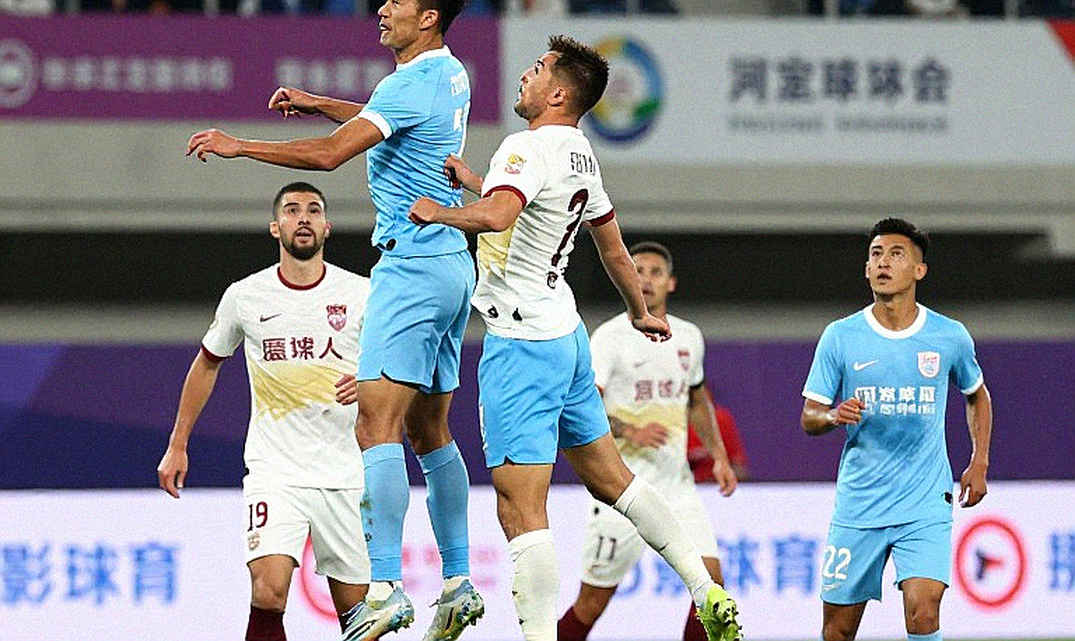
After one round, Hanoi Police sit 15th in the Eastern standings.
There is something I must state before analysing anything, because I have done this work for fifty-one years and I know the price of a rushed conclusion. The report in my hands contains no starting line-up. No formation. No expected goals, no PPDA, no possession share, no shot count. What I have is four goal timings, the names of the scorers, and one crossbar.
Which means: anyone telling you Hanoi Police lost because they "used the wrong system", picked the wrong eleven, or ran out of legs is inventing it. They have no data. Neither do I. What I have is what the match says through the sequence of its own events — and that sequence is enough to see one thing.
Rhythm: the thing no transfer deal can buy
Start with the first goal, because it says the most.
Usami shot from outside the box. In modern football, a goal from that range is rarely a pure accident. It is the product of a defensive block sitting too deep to protect its own penalty area, and in the act of retreating, leaving vacant a strip of ground between midfield and defence — the zone analysts call the "second line", roughly the 18 to 25 metres in front of goal.
When your team collapses inward, you protect the box but open the door to the second line. When the opponent has a player who can strike from distance, you pay twice: once with the goal, and once with the message. The opponent now understands they are permitted to shoot from there, and that nobody will step out to stop them.
By the 58th minute it was 2-0. By the 67th, 3-0.
The third had a different structure: it came from a turnover in the build-up phase. This is the classic continental pattern — a side pressured by a technically superior opponent at the very first point of reception, punished within five seconds.
Superficially the two goals look unrelated: one a long shot, one a turnover. They sit on the same axis. Both were moments in which Hanoi Police lost control of the rhythm of the game — and at continental level, losing rhythm is losing everything.
Hanoi Police's problem tonight was not their defence. It was the speed at which they moved the ball out of their own half — a skill forged at fifteen years of age, and one no transfer deal can buy.
I want to be precise about this, because it is the spine of everything here. There is something in football that the transfer market cannot measure, and that club owners rarely see until they pay for it at a higher level. It is the first touch. It is the question of how a player stands when he receives, which way he turns, how many seconds he has before the press arrives, and whether he already knows.
Academies in Japan teach this very early, through drills that look tedious from the outside: receive with the far foot, angle the body before the ball arrives, scan twice a second. Nothing glamorous. Nothing clip-worthy. And yet that is precisely what creates the distance between a team that can escape pressure and a team that collapses in an instant.
In the V.League, we still tend to coach young players by emphasising physicality, duels, and running more. We build U18 sides that are stronger in order to win youth tournaments, and in the process we shrink the space available to technical players. We teach them to run. We rarely teach them to think before the ball arrives. Then one night they walk into a continental stadium, meet a side whose pressure arrives half a second faster than anything they have known, and that half second becomes the goal on 67 minutes.
The ball does not remember who kicked it. It only remembers the emotions around it. Tonight, in that instant, the emotion was bewilderment.
I have watched matches like this for more than half a century, from rainy nights in England to sunny afternoons in Southeast Asia. The sequence is always the same. The weaker side endures the first fifteen or twenty minutes. They drop deep, they clear long, they slow the game. Then the opponent scores. And then everything breaks.
What was different tonight is that it did not break immediately. Gamba needed until the 29th minute to open the scoring. They needed another half hour to double it. Hanoi Police's defensive structure absorbed the opening pressure — a signal worth noting, not one to dismiss.
But when it broke, it broke into four pieces across barely more than an hour.
Voices from the stands
One thing I do in every match report, in all the years since the pandemic, is go to the supporters before I close. Not to illustrate my argument. To let them write the rest of the story.
A middle-aged supporter in a shirt faded by the years told a reporter that what troubled him most was not the four goals, but the way the team lowered its head after the third. He said: "I can live with losing. What I want is to see the boys take the ball again after conceding. Not to equalise. To show we are still alive."
I record that verbatim, and I will not add to it.
A younger fan, barely into his twenties, read the game differently. He remembered Koko striking the crossbar in the minutes before the opening goal, and said that if that ball had gone in, the whole match might have taken a different road.
He is right. And that is why I must spend part of this piece on what the scoreboard does not say.
The blind spot: collective memory will name one man
This is the part I write with hesitation, because I know it will be cut into a single sentence and circulated in ways I cannot control.
By the following morning, the collective memory of this match will be preserved, in the minds of most, under a single name: Doan Van Hau.
The turnover on 67 minutes is a real event. It led directly to the third goal. There is no way to rewrite it, and I will not try.
But collective memory has a dangerous habit: it turns a symptom into a cause, and a cause into a person. When a collective loses its structure, the final image an audience retains is that of an individual standing alone in the frame, the ball no longer at his feet.
The question few ask is this: why was a full-back of a team already two goals down, in the 67th minute, receiving the ball in a situation where every passing option had been closed before the ball even reached him?
If the answer is "because the team had no other option", then it is the fault of a structure, not of a man. And that structure was built over years, in training sessions nobody filmed, in matches nobody watched.
I have written about quiet training nights for many years. That is where destiny is genuinely forged. A turnover in front of tens of thousands is the outcome of a thousand afternoons with no audience at all.
There is one more thing the table will make you misread. Fifteenth place after one round is not a position. It is an artefact of a table with a single match counted. At this stage of the competition, standings reflect the order of fixtures more than the order of quality. Only after three or four rounds does a table begin to speak in a human voice.
And a third point: Hanoi Police did not simply stand still and take it. They hit the crossbar minutes before the opener. They scored on 79 minutes, when the game was already settled, and they scored through a foreign player. That is not the mark of a side that has surrendered. It is the mark of a side outclassed in quality, not erased in spirit. The difference between those two things is enormous, and it will determine the rest of the campaign.
Perea's goal also says something about squad construction. In the V.League, leading clubs still build their attacking power around foreign forwards. It is a rational short-term choice, but it creates a permanent cost line that never appears on the league's balance sheet. In football, people talk about transfer value as an index of strength. I see it differently: they call it a market, I call it a garden where lives are planted, and a garden that grows only one crop will die in winter.
What to watch next round
Now the part I enjoy most in this trade: talking about what has not happened yet.
The first thing I will watch next round is not the score, but the shape of the team when it has the ball in its own half. How does the full-back receive? Does he have a support option ten metres away? Is the team willing to play a pass back to its own goalkeeper to break the first pressing line — or will it hit long and hand the ball straight back?
These are small details, and they are the entire story.
The second thing I will watch is the reaction after conceding. Not the ability to equalise — the ability to hold the same structure for ten minutes after falling behind. Mature teams do not collapse after the first goal. They slow by one beat, breathe, and continue.
The third, and perhaps the most important in the long run, is whether the coaching staff dare to change how the team plays. At continental level, loyalty to a single system can be a virtue, or it can be a sentence. The line between the two is thin, and it is drawn only by results.
I am sixty-seven, my hair is white, and I write more slowly than I did twenty years ago. But I still believe something I have believed since my first years in a newsroom. Defeat does not need to be dressed as a love song to have value. Some defeats are simply defeats, and the most honest thing we can do is call them by their name.
But there is something else I know for certain, after interviewing so many generations of players: what one football culture passes to the next is not technique. Technique can be bought, taught, copied. What is passed on is the way a team stands up after conceding.
Hanoi Police will have more nights like this. That is the price of stepping outside the comfort zone and playing on a bigger stage. And if, some years from now, a Vietnamese club walks into a continental stadium and keeps the ball at its feet in the 67th minute, tonight will be part of that story — a part nobody remembers, but one that could not be missing.
Somewhere in a stand, a seventy-year-old man will still be sitting after the final whistle, looking toward the tunnel, waiting. Not for a victory. For a sign.
That sign will arrive next round, or it will not. And that is the one thing the league table cannot say on our behalf.